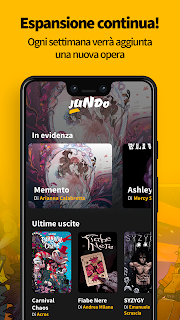
Entering in the Italian publishing world is difficult, especially in the comics field, if you are a rookie. For this reason a young group of writers and artists decided to organize and create a new community “to break the barriers of the comics world”: this community is called JUNDO.
This platform aims to cut the intermediary between artists and readers, giving space to products of any genre, from horror to comedy, from sci-fi to fantasy and slice-of-life. Similar to the format of online publishing services such as the app MANGA PLUS by Shueisha, the works are divided into chapters published over regular intervals of time. Each week there is a new publication, which can be the first chapter of a new series or a new chapter of a series that started earlier!
Page of the series "Carnival Chaos" from Google Play Store
Since its debut in December 2020 up to date, the JUNDO library features 15 works, with an interesting variety of art styles, narration styles and themes, and this is its strength, the richness of diversity of the contents. Another characteristic of JUNDO is the future possibility of buying a physical copy of the comic you read once its publication will be complete on the platform. The printing of the comics will be funded by the price of the monthly subscription of 1,99 euros, and the subscribers won’t pay the shipping expenses. The profit from the books minus the production costs will belong to the artists, following the spirit of allowing them to keep the rights of their own creations and earn as they deserve. What’s more, new artists can pitch their stories or propose themselves as cartoonists! The team picks the artists, pairing cartoonists and writers, and if you are not chosen you will receive feedback with their reasoning and what you can improve for the future.
Preview of the app from Google Play Store
You can create a JUNDO account that will allow you to have one month of free trial to read anything you want, and if you are satisfied you can subscribe for 1,99 euros per month. JUNDO is available on its website as well as its mobile app for Android system and on iOS. JUNDO’s staff usually promotes the platform and its development progress on its instagram and facebook pages, where they publish previews of the soon to be published series as well.
Personally I am very happy about this initiative, it’s a new way for artists that struggle to enter the publishing world, and a new channel to express the creativity of whoever wants to tell a story.
Entrar en el mundo editorial italiano es difícil, especialmente en el sector de los cómics, si eres un novato. Por eso un joven grupo de autores y artistas decidió organizarse y crear una comunidad nueva “para superar las barreras del mundo del cómic”: esta comunidad se llama JUNDO.
Esta plataforma tiene el objetivo de cortar el intermediario entre los artistas y los lectores, dando espacio a productos de cualquier género, del horror al cómico, de la ciencia-ficción al fantástico y al slice-of-life. Parecido al formato de los servicios de publicación en la red como la aplicación MANGA PLUS de Shueisha, las obras son divididas en capítulos publicados en intervalos de tiempo regulares. ¡Cada semana hay una nueva publicación, que puede ser el primer capítulo de una serie nueva o un nuevo capítulo de una serie empezada anteriormente!
Pàgina de la serie "Carnival Chaos" del Google Play Store
Desde su debut en diciembre 2020 hasta la fecha, la biblioteca de JUNDO cuenta con 15 obras, con una interesante variedad de estilos de dibujo, narración y temáticas, y esta es su fuerza, la riqueza de diversidad de los contenidos. Otra característica de JUNDO es la futura posibilidad de comprar una copia física del cómic que has leído una vez completada su publicación en la plataforma. La impresión de los cómics será financiada por el precio de la suscripción mensual de 1,99 euros, y los suscriptores no pagarán el precio de expedición. Los ingresos de la venta de los libros menos los gastos de producción serán todos de los artistas, siguiendo el espíritu de permitir a ellos de mantener los derechos de su propias creaciones y ganar como ellos merecen. ¡Además, artistas emergentes pueden proponer sus historias o pueden proponerse como dibujantes! El equipo selecciona los artistas, emparejando dibujantes y autores, y si no eres seleccionado vas a recibir comentarios que te explican las motivaciones y los que puedes mejorar para el futuro.
Avance de la aplicación del Google Play Store
Se puede crear una cuenta en JUNDO que te permite de haber un mes de prueba gratuita para leer todo lo que quieras, y si estás satisfecho puedes suscribirte a 1,99 euros al mes. JUNDO es accesible en su página web y también en su aplicación para móviles con sistema operativo Android y iOS. El equipo de JUNDO suele promover la plataforma y su proceso de evolución en su páginas instagram y facebook, donde publica también presentaciones preliminares de las series de próxima publicación.
Personalmente estoy muy contenta de esta iniciativa, es una nueva vía para los artistas que tienen dificultades para entrar en el mundo editorial, y un nuevo canal para expresar la creatividad de cualquiera persona que quiere contar una historia.
So on Michela Atzeni's account I found a trailer for the short film we talked about earlier! It seems the title of the product changed from Faulas si credia to simply Faulas.
We can see the stop-motion animation uses characters created with paper puppets, with an aesthetic that resembles the illustrations of children’s books colored with markers. Personally I believed that this is a really good and charming effect.
In the credits, the names of the staff working with Michela Atzeni are different from the ones I previously presented, this is because that’s the final team for the short film. Michela Atzeni writes, directs and works on the animation, Giulia Pes takes care of the storyboard (which is planning the movements of the characters), while the character design is by Marina Brunetti.
The narrator’s voice will be Lia Careddu, with music by Simone Mura, photography of Federica Ortu and color grading by Damiano Picciau, under the organization of Laura Biagini and Mommotty’s executive production. One can speculate that the people previously involved in the team are working on another project for Mommotty.
Stay tuned for more news and trivias about the world of animation!
¡Bueno, en la cuenta de Michela Atzeni encontré un pequeño avance del cortometraje del que hablamos anteriormente! Parece que el título de la producción cambió de Faulas si credia a simplemente Faulas.
Podemos ver que la animación en stop-motion utiliza personajes creados con marionetas de papel, con una estética parecida a la de las ilustraciones en cuentos para niños coloradas con marcadores. Personalmente creo que es un efecto muy bonito y gracioso.
En los créditos, los nombres del equipo que colabora con Michela Atzeni son diferentes de los que presenté anteriormente, eso es porque este es el equipo definitivo para el cortometraje. Michela Atzeni escribe, dirige y trabaja en la animación, Giulia Pes se ocupa del storyboard (es decir la planificación del movimiento de los personajes), mientras que el character design (el diseño y la estética de los personajes) es de Marina Brunetti.
La voz narradora será Lia Careddu, con las músicas de Simone Mura, con la fotografía de Federica Ortu y color grading de Damiano Picciau, bajo la organización de Laura Biagini y la producción ejecutiva de Mommotty. Es posible especular que las personas previamente implicadas en el equipo trabajan sobre otro proyecto para Mommotty.
¡Hasta luego con más novedades y curiosidades sobre el mundo de la animación!
This short film is a collection of sayings of the popular tradition, of stereotypes and expressions contextualized through rhymes that explain their meaning, in the form of fables.
Produced by Mommotty, the short film will be directed, written and animated by Michela Anedda, with the music of Emanuele Contis and the voice of Michela Atzeni. The animation technique will be one of my favorites, stop-motion. This type of animation consists in simulating the movement of static objects through a series of still images in succession. With this technique you can create animated movement of any object by taking sequential pictures. The possibilities are infinite: toys, articulated dolls, clay, sand, paper cutouts (as we saw in the case of the animated collage), and people as well! In the last case it’s a more specific technique called pixilation that uses the same principles with people instead of objects.
The stop-motion technique was also used for the special effects in famous films such as the first iteration of King Kong in 1933, the terrific effects of Beetlejuice (1988) and the formidable Gremlins in several scenes from the namesake features, alternating with the use of animatronic puppets. Famous examples of stop-motion animation are: films by company Aardman animations such as Wallace y Gromit, Chicken Run, Shaun the Sheep Movie; Coraline, Kubo and the Two Strings and ParaNorman by Studio Laika; and finally the Swiss-British series Pingu.
One of the most known examples of stop-motion in Italy is the series Mio and Mao by studio Misseri, charming product animated with claymation starring two curious kittens that explore their colorful world. The same studio produced in collaboration with NHK a series, Pozzie, animated using real droplets of water to create moving figures, with a new technique! Personally I believe that studio Misseri deserves an article on its own devoted to its products, it might happen in the future!
Mio and Mao from studio Misseri's page
Pozzie from studio Misseri's page
Michela Anedda has a degree in Industrial Design at the University of Studies of Sassari and achieved a Master of Arts in animation at the Edinburgh College of Art with the production of short film Cogas: selected for numerous national and international film festivals, it won Best Italian Animation at Sardinia Film Festival. She participated in the university research project for the visual communication of Region Sardegna at Expo. As a freelancer she collaborates with Sardinian directors and directs animated short films: among them is “Sei tu il nostro eroe” for Sardegna Film Commission’s Heroes 20.20.20 project, selected at Brazilian festival Anim!Arte. Michela Anedda organizes stop-motion animation workshops as well for adults, young adults and kids.
In several occasion her work was part of documentaries: in 2018 her stop-motion animation contributed to the narration of “L’Uomo con la Lanterna” directed by Francesca Lixi, that pieces together the life of her uncle as worker for the Italian Bank of China in the 1920s, thanks to pictures and recordings in 8mm film, and how discovering this past influenced the life of Francesca Lixi herself.
What’s more, in 2019 she worked on the motion graphics of the short documentary “Ràixe - Spazi digitali per la cultura tabarchina”, produced by Ginko Film as multimedia content for the museum of Calasetta. The documentary narrates the fascinating history of the tabarchino people and their nomadic path through Mediterrean through the centuries.
Michela Atzeni is a theatre actress, performer and voice director. After her theatre training she studied acting at Teatro dei Filodrammatici of Milan and in 2014 she graduated at the School of Voice Acting at Centro O.D.S. of Turin, for which she did her first voice acting gigs. Since 2010 she has been collaborating with Sardegna Teatro in different theatre productions that tour at national level. She read numerous audiobooks for the platforms Storytel.it and Audible.com. She is chief of the company QUARANTACINQUE audiolibri e doppiaggio and is producer, reader and curator of audiobooks distributed nationwide and dubbing and voice over services. We can listen to her voice in an extract of the audiobook “Sentinella della pioggia” on Audible.com.
Emanuele Contis is a Sardinian musician and composer. After a short period as engineer, he discovered his real calling and studied further music, his passion, at Berklee College of Music in Valencia. A passion that he has since he played the saxophone at the age of 6, and that now is his job. He is the founder of INDÒRU - Boutique del suono, a creative studio for music and sound based in Sardinia: in INDÒRU he composes music for tv series, short films, advertisement, and the soundtrack for his first long film as well. You can listen to examples of his work on soundcloud and his personal website.
I adore stop-motion’s aesthetic, especially when clay is used, furthermore the saying and idioms fascinate me, because of this I believe it could become one of my favorite short films when it is released!
The next and last short film will be “La Rondine”, representing the theme of sustainability, climate change and quality of life, stay tuned!
Este cortometraje es una recolección de dichos de la tradición popular, de estereotipos y expresiones contextualizados dentro de rimas que explican su significado, bajo forma de cuentos de hadas.
Producido por Mommotty, el cortometraje será dirigido, escrito y animado por Michela Anedda, con las músicas de Emanuele Contis y la voz de Michela Atzeni. La técnica de animación es una de mis favoritas, el stop-motion. La animación en volumen o animación fotograma por fotograma, definida más recientemente como stop-motion también, consiste en simular el movimiento de objetos estáticos a través de una serie de imágenes fijas en sucesión. Con esta técnica se puede producir movimiento animado de cualquiera objeto sacando fotografías y poniéndolas en secuencia. Las posibilidades son infinitas: juguetes, muñecas articuladas, plastilina, arena, recortes de papel (como vemos en el caso del collage animado), ¡y personas también! En el último caso se habla de una técnica más específica llamada pixilation que utiliza los mismos principios con las personas en lugar de objetos.
La técnica del stop-motion ha sido utilizada también para los efectos especiales en películas famosas como por ejemplo la primera interpretación de King Kong en 1933, los terroríficos efectos de Beetlejuice (1988) y los temibles Gremlins en algunas escenas de las homónimas películas, alternados al utilizo del muñecos animatronicos. Ejemplos de animación stop-motion célebres son: películas de la compañía Aardman animations como Wallace y Gromit, Chicken Run: Evasión en la granja (conocido también como Pollitos en fuga), La oveja Shaun: La película (Shaun, el Cordero: La película); Coraline, Kubo y las dos cuerdas mágicas y El alucinante mundo de Norman (ParaNorman) del estudio Laika; y por fin la serie suizo-británica Pingu.
Uno de los más célebres ejemplos de stop-motion en Italia de la serie MioMao por estudio Misseri, cariñoso producto de animación con plastilina protagonizado por dos gatitos curiosos que exploran su mundo colorado. ¡El mismo estudio produjo en colaboración con NHK una serie, Pozzie, animada utilizando gotas de verdadera agua para crear figuras en movimiento, con una técnica nueva! Personalmente creo que el estudio Misseri merece un artículo entero dedicado a sus producciones, ¡podría pasar en el futuro!
MioMao desde la página de estudio Misseri
Pozzie desde la página de estudio Misseri
Michela Anedda es graduada en diseño industrial en la Universidad de Estudios de Sassari y consiguió un Master of Arts en animación al Edinburgh College of Art con la producción del cortometraje Cogas, seleccionado en numerosos festivales de cine italianos y internacionales, ganó el Best Italian Animation al Sardinia Film Festival. Participó en el proyecto de investigación universitaria para la comunicación visual de la Región Cerdeña al Expo. Como profesional independiente colabora con directores sardos y dirige cortometrajes animados: entre ellos “Sei tu il nostro eroe” para el proyecto Heroes 20.20.20 de Sardegna Film Commission, seleccionado al festival brasiliano Anim!Arte. Michela Anedda organiza también laboratorios de animación stop-motion para adultos, jóvenes adultos y los más pequeños.
En diferentes ocasiones su trabajo hizo parte de documentales: en 2018 su animación stop-motion contribuyó a la narración de “L’Uomo con la Lanterna” dirigido por Francesca Lixi, que reconstruye la vida se su tío como trabajador de la Italian Bank of China en los años 20, gracias a fotografías y grabaciones en película 8mm, y como descubrir esto pasado influyó en la vida de Francesca Lixi misma.
Además, en 2019 trabajó en la gráfica de movimiento (motion graphics) del breve documental “Ràixe - Spazi digitali per la cultura tabarchina”, producido por Ginko Film como contenido multimedial para el museo de Calasetta. El documental cuenta la fascinante historia del pueblo tabarquino y su recorrido nómada por el méditerraneo en el curso de los siglos.
Michela Atzeni es actriz de teatro, actriz y directora de doblaje. Después de la formación teatral estudió interpretación en el Teatro dei Filodrammatici de Milán y en 2014 se graduó en la Escuela de Doblaje del Centro O.D.S. de Turín, para el que hizo su primeros trabajos de doblaje. Desde 2010 colabora con Sardegna Teatro en diferentes producciones teatrales que giran a nivel nacional. Ha leído numerosos audiolibros para las plataformas Storytel.it y Audible.com. Ella es jefe de la compañía QUARANTACINQUE audiolibri e doppiaggio y es productora, lectora y curadora de audiolibros con distribución nacional y servicios de doblaje y locución. Podemos escuchar su voz en un extracto del audiolibro “Sentinella della pioggia” en Audible.com.
Emanuele Contis es un músico y compositor sardo. Después de un breve periodo como ingeniero, descubrió su verdadera vocación y profundizó en el estudio de la música, su pasión, al Berklee College of Music de Valencia. Una pasión que él tuvo desde que tocó el saxofón a los seis años, y que ahora es su profesión. Desde 1997 gira por Italia con diferentes artistas nacionales adaptándose a todos los estilos, convirtiéndose en un personaje conocido por la improvisación y versatilidad artística. El es el fundador de INDÒRU - Boutique del suono, un estudio creativo musical y de sonido con base en Cerdeña: en INDÒRU el compone música para serie tv, cortometrajes, comerciales, y también la banda sonora para su primer cortometraje. Podéis escuchar ejemplos de su trabajo en soundcloud y su sitio personal.
Yo adoro la estética de la técnica stop-motion, especialmente cuando utiliza la plastilina, además los dichos y expresiones me encantan, ¡por eso creo que esto podría convertirse en uno de mis cortometrajes favoritos cuando esté disponible!
El próximo y último cortometraje será “La Rondine”, que representa el tema de sostenibilidad, cambio climático y calidad de vida, ¡hasta luego!
Some time ago I discovered in the stream of content of Youtube a series of very charming videos, starring the most famous blue dog of American animation: Huckleberry Hound, known in Italy as Huckleberry Hound! I thought: “What, a Braccobaldo short animated here?” Well yes! These shorts films created between 1967 e 1969 by Organizzazione Pagot for the firm Locatelli and presented in the advertising interstitial show Carosello were paired with the food product “Formaggini Mio”.
Carosello was created in 1957 as a program of the recently born Italian public television (RAI, Radio Televisione Italiana) that used to include a small show and commercials. Its first broadcast happened on February 3rd 1957 at 20:50 with a defined pattern of the duration of the statements. Every product consists of 2 minutes and 15 seconds, divided in 1 minute and 45 seconds of show and a maximum of 30 seconds of commercial. What’s more, the sponsor could use its name in any form in the show for up to six times. This challenge for the studios encouraged the imagination of the authors, who managed to create different situations with the same characters in order to reduce the production costs. The audience quickly developed an affection for these characters, continuing to watch Carosello every night. For the first two years Carosello aired everyday at 20:50 except on November 2nd (commemoration of the dead) and Good Friday, with four short films during 2 minutes and 15 seconds each, still being the only advertising space of Italian television.
Since 1958, among the short films animated productions have debuted. The first short film was “Telequiz” with the little man with the moustache, “l’Omino coi Baffi”. In 1962 Huckleberry Hound debuted on Italian television screen with the “Braccobaldo Show”, starring him, Yogi Bear and BooBoo, and Pixie, Dixe and Jinks the cat. Around those years the animated short films “Looney Tunes” and “Merrie Melodies” were known in Italy as well, and for this their characters loved by children and the whole audience were protagonists of a few Carosello short films. Huckleberry Hound appeared in approximately seven short films, Yogi in one, the Flintstone in three and finally Sylvester the cat in nineteen short films.
L'Omino coi baffi with Moka Express coffee pot. His mouth is animated in the shaped of the letter he's pronouncing.
The thing is that up to date the number is not certain, because part of the content broadcasted n Carosello is currently lost. For some reasons, since the conclusion of the interstitial show in 1977, part of the short films was intentionally discarded, probably because back then the archives needed more storage space. Part of the content is available as well in Rai Teche, the institution devoted to the conservation and valorization of the audiovisual material produced and broadcasted by Rai. Luckily, a dedicated community of fans is working to recover and document those who are currently “lost media”. Thanks to this community’s website, Il Mito di Carosello, I could report the most precisely possible up to date the short films of our blue dog and his friends. Here I will share one short film for each character, most of the others can be found on Youtube pairing the name of the character with “Carosello”, Let’s see the products advertised by each of them.
Huckleberry Hound was paired with the producto “Formaggini Mio”, small light cheese pieces loved by children (in my opinion they taste really good!) and the recurring theme in his adventures is travelling to other countries with his wife and son (characters created in Italy, originally he has a girlfriend but it was a different character).
Yogi and BooBoo were paired with the San Carlo products. Up to date only one short film was found, in which the two bears manage to avoid Ranger Smith’s traps and steal a truck full of San Carlo products. It’s legit to think that the other possible shorts had the same theme.
The Flintstones represented the “Neocid florale” bug spray. The only short film available on video up to date of the three documented features Fred and Barney trying to catch worms for fishing, with a few misadventures. Probably the other two short films have the same kind of daily stories with Fred, Barney, Wilma and Betty.
The long list of short films of “Silvestro gatto maldestro” (Silvester clumsy cat) show the different and equally crazy attempts to eat the little bird Tweety. Each time the chase is interrupted once Tweety hides behind a can of tomato sauce DeRica and Silvester says “Oh no, you can’t over DeRica!”
Personally I believe that the animated productions created for Carosello are a very interesting treasure that waits to be discovered by more people and I’d like to talk more about these collaborations and the original characters as well, icons of Italian pop culture in the 60s and 70s.