Mostrando entradas con la etiqueta comics. Mostrar todas las entradas

lunes, 30 de mayo de 2022

The Multimedia Archive of the Image opens in Cagliari

Great news for comics and animation fans: on May 12th in Cagliari the Multimedia Archive of Image (Archivio Multimediale dell’Immaginario, AMI) was presented to the press. Produced by the fervent activity of International Comic Center (Centro Internazionale del Fumetto, CIF), the AMI archive gathers an incredible amount of multimedia material, most of which is related to the comic world: magazines, series, comic books, graphic novels and essays on the history and characteristics of the visual medium. 

A room in the AMI archive
(source: falzarego35.eu)

You can find complete collections of Corriere dei Piccoli of 1940 and from 1960 to 1972, the first editions of the Supereroi issues by Editoriale Corno, the anastatic reprints, that is accurate reproductions of the original copies, of magazine Linus from 1965 to 1980 and the complete collections of anthological magazines Totem, Comic Art, Pilot and Eureka. It also features a section of international comics from all over the world, such as China, Russia, Brazil, Argentina and many others. Regarding animation, there are essays and movies on DVD, together with documentation on television, multimedia material and literary essays. The heritage of secondary material isn’t lacking: stickers, playing cards, tarots, illustrated and satirical magazines from mid 19th century to the 1960s such as Illustrazione Italiana, Illustrazione Popolare, Lo spirito Folletto, Il Giornalino della Domenica and photo story books such as Avventuroso Film.

This archive is inside the International Comic Center, in the library hub Polo Bibliotecario Falzarego 35 with other five socio-cultural realities: the Center for Documentation and Women Studies, the LGBT and Queer Media Library, the Documentation Center for performing arts Marco Parodi, the Performing Arts and Crafts Library and the Center of multimedia documentation fo the humid areas. The library hub headquarters are in Via Falzarego 35 in Cagliari, which for fifty years (from the early 1950s to the early 2000s) hosted one of the city’s most important primary schools, Edmondo De Amicis school. From 2018 it hosts the International Comic Center, adding other cultural activities through the years. 

In the presentation of the AMI archive, attended by Cagliari’s Councilor for Culture Maria Dolores Picciau and Pasquale Mascia, coordinator of the Office for the Historical Archive and Libraries and of the Municipal Library System, writer and director Bepi Vigna explained:

“Our International Comic Center collects material and traces of the popular narrative production that fostered our imagination. Basically, we propose a new way to approach history involving everyone. Because we are what we dreamed, we are the books we read, the films we watched, the music we listened to. We are the games we played as children… We are our memories. Through comics and books, in the pages of illustrated magazines, in films and tv series, in songs we loved, we can find what can help us understand ourselves better and estimate the world changes we went through and understand its value system.”

Presentation of the AMI archive with Pasquale Mascia, Maria Dolores Picciau and Bepi Vigna
(source: falzarego35.eu)

Bepi Vigna, director of the International Comic Center, was born in Baunei (Ogliastra, Sardinia) in 1957. He worked for many years as a lawyer until the founding in Cagliari of the group Bande Dessinée with Antonio Serra and Michele Medda. The three wrote comic scripts for Sergio Bonelli Editore, and in 1989 they proposed to the editor Nathan Never, SBE’s first sci-fi series, which debuted in 1991 and is currently quite popular in Italy and in many other countries. In 1995 one of the series’ secondary characters became the protagonist of her own spin-off, Legs Weaver, published from 1995 to 2005. In 1990 he published with the newspaper L’Unione Sarda the book Luoghi ed esseri fantastici della Sardegna, written with Giampiera Caprolu on the legendary creatures of Sardinia. In 1993 Vigna founded in Cagliari the region’s first school of comics, which now is part of CIF. He is also the author of essays on comics, cinema and popular traditions, short stories and novels. In 2006 he started directing the Sardinian magazine of comic and illustration Backgroiùund and the cinema magazine Teorema. He directed several short films and documentaries, such as Imago Sardiniae, a documentary in three parts about the history of Sardinian comics in the 20th century. 

Part of the archive is dedicated to Sardinian comics: the cataloging of material recently started and for each author a personal box is prepared. The curator of the census of documents Elisabetta Randaccio states:

“In the boxes where the works of Sardinian artists are cataloged you can find great surprises: not just publications, newspaper articles, but also painting works, original scripts for comics and graphic novels in an extraordinary overview of Sardinian creativity in comics. Cataloging through boxes and cards facilitates very much consultation and study of the materials.”

The archive’s material comes from relations with national and international institutions such as the Institut National des Beaux-Arts and the Forum International de la Bande Dessinée de Tétouan (Morocco) and the literary festival Semana Negra de Gijón (Spain) among many others. Furthermore, great contributions come from donations of private collectors, such as former professor, author and musician Fulvio Caporale, honorary associate of the Center: among this material are an illustrated French newspaper from 1789 and a book of Roman Smorfia from 1810 with late 18th Century engravings. This archive will be an incredible resource for aficionados and students for their personal research and essays, a testament of Italian popular culture. 

You can visit the Multimedia Archive of Image by prior appointment by writing to the email address centrointernazionalefumetto@gmail.com.

jueves, 12 de mayo de 2022

Thermal baths and time travel: Thermae Romae by Mari Yamazaki

Cover of Thermae Romae
vol. 4 with Lucius' bust
Sometimes elements that don’t seem to have anything in common can reveal themselves as a surprising combination: this is the case of the funny story of Thermae Romae, a manga written and drawn by Mari Yamazaki. The comic was published by the magazine Comic Beam in 2008 and later in six tankobon volumes; the volumes were published in Italian by Star Comics in 2011, in English by Yen Press in 2012 and in Spanish by Norma Editorial in 2013. The story follows the Roman engineer Lucius Modestus, who designs and builds thermal baths in ancient Rome. In a moment of relaxation at the baths, Lucio is dragged to the bottom of the pool and mysteriously transported in a thermal spring in modern Japan. The engineer doesn’t understand he traveled through time, but rather he thinks he is in a colony of the Empire, in one of the thermal baths for the “flat-faced people”, while the locals think he is a foreign tourist. A man kindly offers him a bottle of fruit-flavored milk, and in one of the most memorable scenes of the series Lucius is surprised by the beverage’s delicious taste.

Lucius emerges for the first time
in a Japanese thermal bath
Completely amazed and fascinated by this odd colony’s technology, once he returns as mysteriously as he arrived, Lucius tries to reproduce the innovations he saw. Very soon Romans appreciate Lucius' innovative genius, who keeps accidentally traveling through time every time he has difficulties with an important job. Lucius is happy to contribute to the improvement of Roman people and the Empire’s wellbeing, but being effectively modest, as his last name says, he feels a bit of an impostor because he was inspired by the mysterious colony he keeps visiting. Modest, anxious, dedicated to work and altruistic, Lucius is a protagonist the reader can sympathize with and even root for. Most of the series’ humor lies in Lucius’ reactions to the modern world and his attempts to interact with people without understanding a single word of Japanese. Furthermore, Lucius develops a feeling of great admiration towards Japanese people, to the point of having occasional little crises in his Roman pride.

The author Mari Yamazaki

The red thread connecting Roman and Japanese culture is the importance and value of relaxing in a hot tub, whether in company or alone. The concept of public baths in which you rest after the daily efforts quietly without disturbing the peace of the neighbors is as much part of the Roman thermal culture as the Japanese. Lucio’s appreciation for the Japanese baths (called onsen) and his ability to recreate some of their tools with the Roman technology of the second century b.C. are a love letter from the author to both cultures. In fact, Mari Yamazaki studied and lived in Italy for several years, and she wanted to bring together her knowledge of the Greek/Roman world with her experience in the Japanese thermal baths: the result is a funny and very informative series because it’s historically accurate too. In each volume there are in-depth articles by the author on a particular element present in the story, such as, for instance, the tools used in the Roman thermal baths. Thermae Romae is the first series of a trilogy on the link between the Greek/Roman world and modern Japan: the other two are Plinius (2013, with a more academic approach on the scholar and naturalist Gaio Plinio and emperor Nero) and Olympia Kyklos (2018, featuring amphorae painter Demetrios who arrives in the olympic Tokyo of 1964).

Poster of Thermae Romae
by Netflix

Thermae Romae has two live-action films and two animated adaptations: Thermae Romae I (2012) and II (2014) directed by Hideki Takeuchi; six episodes realized by Dream Link Entertainment in collaboration with studio Gonzo in 2012, which were not distributed outside of Japan; and the new 2022 series Thermae Romae Novae in collaboration with Netflix, distributed world wide. The current animated series has a higher budget and is very appreciated by the audience, thanks to its good animation, quite beautiful scenery and a fantastic soundtrack. Furthermore, each episode is accompanied by a segment in which Mari Yamazaki visits thermal baths and you learn something about the thermal activity. Both the comic and the 2022 animated series are ideal for a moment of levity and fun learning. Maybe you could read it after a warm bath!

jueves, 30 de diciembre de 2021

Fantomius, Disney Italia's gentelman thief

With the debut of the Diabolik film in cinemas this month I decided to stay on topic by talking about another famous thief of Italian comics: Fantomius gentleman thief. In order to talk about him we need a bit of context on his history and the long series of parodies and homages made by Italian Disney comic artists.

In 1969 authors of Topolino magazine Guido Martina and Giovanni Battista Carpi and editor-in-chief Elisa Penna created an alter-ego for Donald Duck: Paperinik, identity that allows Donald to have vindication against the misadventures of his daily life. Paperinik started as a bit of a humorous entity (one of his first achievements was stealing his uncle Scrooge McDuck’s mattress as a personal revenge), but soon Paperinik uses this new identity and his gadgets created by Gyro Gearloose to help people and fight crime as a vigilante. In Paperinik e il diabolico vendicatore Donald is inspired to take this second identity by the diary of Fantomius, who operated as a thief during the 1920s and had his home Villa Rosa in Duckburg as his base. Along with the diary, Donald found the famous thief’s costume as well and took it for his own adventure as Paperinik.

"Paperinik e il segreto di Fantomius"
by Marco Gervasio (2011)

For a long time Fantomius was a mystery, very little was known about his life other than his exploits and he had been mentioned in a few Paperinik stories only through his diary. The beginning of the character’s reinterpretation happens in four stories: Paperinik e l’ombra di Fantomius (2003), Paperinik e il tesoro di Dolly Paprika (2007), Paperinik e il segreto di Fantomius (2011) e Paperinik e il passato senza futuro (2012), which work as prologue for the official series dedicated to Fantomius set in the 1920s.

This new phase of the character’s management is led by Marco Gervasio, Disney writer and artist, who established a much clearer and more defined identity of the gentleman thief, exploring his adventures in his own series of stories, periodically published on Topolino. The saga Le strabilianti imprese di Fantomius ladro gentiluomo started in 2012 with the story Il Monte Rosa published on November 13th 2012 on Topolino n.2972. The first four stories were released in the span of four weeks on the magazine, to present the character, his friend allies and his enemies and rivals. Later, the thief’s adventures were released on a more free schedule, accounting to this day to a total of 27 stories plus the four of the prologue.

Cover of Definitive Collection n.0
with the four prologue stories

Fantomius, like Diabolik (one of his inspirations), takes elements from 1910s French novels about the thief Fantômas, with whom Fantomius has in common the blue mask as well.

Fantomius’ true identity is Lord John Lamont Quackett, a young noble fond of Robin Hood’s adventures stories who doesn’t appreciate the hypocrisy of the society of the time and feels alienated by his peers, because they consider him a slacker. Inspired by his favorite thief, Fantomius steals from the rich to give to those who need (and a bit for himself) and the thrill of the challenge: the more the exploit seems difficult, the more fun it is.

The series presents gadgets that were already mentioned in the diaries found by Donald and many new ones. The devices, created by his inventor friend Copernico Pitagorico (ancestor of Gyro, who helps Paperink in the present), sometimes are anachronistic inventions, that is they precede the real date of invention: for instance, in Il ladro e il miliardario, set in 1922, Fantomius uses a reel in which he can be heard talking, while in reality sound in films was achieved later, in 1927

Dolly Paprika, Fantomius
and Copernico in n.2
of the Definitive Collection

Like Diabolik, the duck thief has a partner both on the job and in private life: Dolly Duck, who works with Fantomius under the name Dolly Paprika. The two thieves are always chased by commissioner Pinko, a very determined but also unlucky character and source of part of the series’ gags. Through the series Marco Gervasio managed to build a group of characters with a defined personality and a detailed personal history, to the point that in the Definitive Collection volume edition you can read a timeline for each member of Fantomius’ gang. 

All three of them have a family history that gets explored in several stories, including the story of their first meetings and the formation of the gang. The brother that inspired John Quackett to become a gentleman thief, the ballet dancer training and the irritation towards the upper class that shaped Dolly Duck, and the conflictual relationship between Copernico and his twin brother Cartesio are some of the elements that make the characters interesting and charismatic.

Homage to Laurel & Hardy
in "Silenzio in sala"
(source: ventennipaperoni.com)

The attention to the 1920s historical context allows to create peculiar stories: Silenzio in sala, published on April 1th 2012 on Topolino n.2994, is an homage to silent films, and because of this the story is without dialogues! In addition, in a chase between Fantomius and Pinko through the Hollywood movie sets you can see homages to Nosferatu (1922), The battle of the century (1927) starring Stan Laurel and Oliver Hardy (known in the first years in Italy as Cric e Croc before being called Stanlio e Ollio), Sins of Rome (1953) and Shane (1953). The last two are an example of anachronism because they didn’t exist yet in the 1920s, but it is a sort of artistic license, an intentional homage.

Visually, the Fantomius series stands out from the regular Topolino stories due to its more desaturated color palette, which goes well with the time period of the story. In addition, the caption squares are decorated, in contrast with the simple squares of the regular stories.

First page of "Il Monte Rosa"
by Marco Gervasio (2012)

Le strabilianti avventure di Fantomius has elements in common with Diabolik, but with a lighter and humorous atmosphere keeping the charm of the mystery intact; from this point of view it’s closer to the animated adventures of Lupin III. Fantomius is definitely one of the most interesting characters that the Italian side of Disney comics gave us in its very long history, and that still has the potential to keep telling new adventures.

domingo, 3 de octubre de 2021

Dylan Dog's first cover artists: Claudio Villa and Angelo Stano - 35 years of Dylan Dog

Dylan Dog turns 35 years old! The nightmare investigator debuted in the newsstands on September 26th 1986 and since then he accompanied readers every month through the decades to this day. Recently we talked about Dylan Dog’s current cover artists, this time I want to celebrate the anniversary of the series with the cover artists of the “classic” era: Claudio Villa and Angelo Stano.

Cover of Dylan Dog n.1
by Claudio Villa

Claudio Villa debuted in the comic world after graduating from art school, drawing for edizioni L.U.G. the medieval miniseries Enguerrand e Nadine and the sci-fi comic Gun Gallon. In 1982 he started collaborating with Sergio Bonelli Editore (back then called Daim Press) for issues 11-12 of the series Martin Mystère, for which he drew nine stories in total. After working on four stories the publishing house commissioned a test to draw pages for Tex, which he passed successfully, working later on a script written by founder Gian Luigi Bonelli.

Cover for "Le vie dei colori"
by Claudio Villa

In 1986 he was contacted by Tiziano Sclavi for the character design of a new character, Dylan Dog. Sclavi provided Ville with all the material gathering the “creative process” and reference images for the faces that inspired him. His first attempts weren’t very satisfying: Dylan is a British man and his studies had traits that were <<kind of Hispanic with thick hair, sideburns and a big nose>>. Once they understood that Dylan is British, they decided to use Rupert Everett’s face as inspiration, and with a few adjustments we reached the definitive appearance of the character. Claudio Villa took care of the covers for the first 41 issues. In 1996 he wrote and drew in collaboration with singer songwriter Claudio Baglioni the story Le vie dei colori starring Dylan Dog, published in color in the magazine Tutto Musica e Spettacolo. In an interview with Lo Spazio Bianco in 2015 he stated that this was his first experience as a cover artist and it was very formative: <<The opportunity of working on the covers was a real gym>>.

Cover of Dylan Dog n.42
by Angelo Stano

He then took care of the character design of Nick Raider, a character created by Claudio Nizzi that debuted in 1988. He took up the baton as cover artist for Tex after Galep in 1994, drawing many issues as well. In 2006 he drew the story Devil & Capitan America: Doppia Morte with the script by Tito Faraci, a production from Marvel Italia. From 2007 to 2011 he drew the covers for Tex’s Collezione storica a colori, a collection of Tex’s stories in color in collaboration with publisher group L’Espresso. Claudio Villa also works on covers for Bonelli comics’ international editions.

Tarot card of The Judgment
drawn by Angelo Stano

Angelo Stano got the art high school diploma in 1971 and debuted in the comic world in 1973 drawing an adaptation of From Earth to the Moon by Jules Verne according to Roberto Catalano’s script, published by Editrice Sole. He worked for several publishers, among which Ediperiodici, Edifumetto, Corrier Boy and Universo. He taught at Milan’s Scuola di Fumetto from 1981 to 1999. In 1985 he entered the team of authors that created Dylan Dog, drawing the first issue of the series, L’alba dei morti viventi. Then he worked on many stories of the series, and in 1990 he took up the baton from Claudio Villa as the series’ cover artist from issue 42. His last cover was issue 361, Mater Dolorosa, followed by the blank cover of Dopo un lungo silenzio, leaving the baton to Gigi Cavenago in issue 363. Occasionally he keeps drawing stories for the main title: his most recent one is issue 417, L’ora del giudizio, written by Barbara Baraldi and published in May 2021. During his career Stano also drew covers for the titles Speciale Dylan Dog (1990-2014) Maxi Dylan Dog (1998-2014), Dylan Dog Gigante y Almanacco della Paura.

Cover of Dylan Dog n.315
by Angelo Stano

In 2012, Angelo Stano worked on script, drawings and cover of issue 315, La legione degli scheletri, an exceptional case because issues are usually a work of two authors plus the cover artist. In addition, in 1991 he drew the illustrations for the Tarocchi di Dylan Dog, tarot cards created in collaboration with publisher Lo Scarabeo that represent the major arcana with the characters of the series.

On occasion of issue 400, Claudio Villa and Angelo Stano came back to create special covers together with Gigi Cavenago and Corrado Roi, who was not a cover artist for the main title but he is one of the most memorable artists of the comic series.

Covers of Dylan Dog n.400 by Gigi Cavenago, Claudio Villa, Angelo Stano and Corrado Roi

This time as well I will show my favorite covers to celebrate the artists of the classic era of Dylan Dog.


Cover of Dylan Dog n.25, “Morgana”, October 1988, Claudio Villa. One of the most memorable covers, due to its composition as much as for the introduction of the character of Morgana.


Cover of Dylan Dog n.44, “Riflessi di morte”, May 1990, Angelo Stano. I especially like the shadow and the inclusion of the title in the composition, with the sword covering one of its letters.


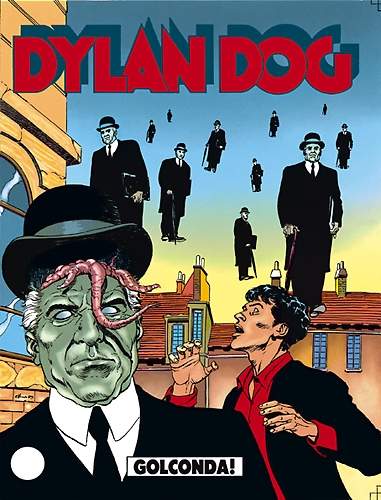
Cover of Dylan Dog n.40, “Golconda!”, February 1990, Claudio Villa. The cover is an homage to the painting Golconde by René Magritte in a horror key. 


Cover of Dylan Dog n.63, “Maelstorm!”, December 1991, Angelo Stano. A surreal passage-way room, where you can’t tell up from down and different supernatural creatures meet.


Cover of Dylan Dog n.16, “Il castello della paura”, January 1988, Claudio Villa. The veiled lady and her marvelously detailed gown are the protagonists of the composition.


Cover of Dylan Dog n.120, “Abyss”, September 1996, Angelo Stano. The objets and marine fauna are portrayed very thoroughly, personally I quite like the perspective the razor is represented with.

martes, 7 de septiembre de 2021

Change of cover artist for Dylan Dog: leaves Gigi Cavenago, enter Raul and Gianluca Cestaro

The month of September starts with important news in Dylan Dog’s main series: the cover artist that accompanied readers for the past years, Gigi Cavenago, passes the torch to the brothers Raul and Gianluca Cestaro starting from issue 421. The series curator, Roberto Recchioni, explained in the comments of the announcement of issue 420’s newsstand release that Cavenago currently has other priorities and for this he had to leave his role as cover artist.

Cover of Dylan Dog n.420 by Gigi Cavenago

Gigi Cavenago debuted in the comics world in 2005 in the magazine Strike published by Star Comics with a short story called “Predatore naturale”. Then he worked for the new series of Jonathan Steele drawing several issues. He alternates the activity of comic artist with his job as illustrator for publishers and advertisements. He debuted at Sergio Bonelli Editore as part of the staff for the miniseries Cassidy (2010), he was chosen for the series Orfani in 2013. He started drawing covers for the secondary title Maxi Dylan Dog Old Boy in 2014 and debuted as cover artist in the main series in November 2014 with issue 363, Cose perdute (Lost things), written by Paola Barbato with art by Giovanni Freghieri, taking the torch from cover artist Angelo Stano.

Cover of Mater Dolorosa by Gigi Cavenago


Furthermore, before his official debut as cover artist, Gigi Cavenago drew in color issue 361, Mater Dolorosa, written by curator Roberto Recchioni to celebrate 30 years of Dylan Dog. This issue is available in its newsstand edition, with cover by Angelo Stano, and in hardcover and bigger size edition as well for bookstores, that can be read in Italian, English and Brazilian Portuguese. In February 2019, the Cestaro twins started to work on the covers for Maxi Dylan Dog Old Boy, with very nice results.

Cover of Dylan Dog n.421
by Raul and Gianluca Cestaro


Raul and Gianluca Cestaro debuted in the comics world in the second half of the 90s with the short story “Il Fulmicotone” in a fanzine for the Lucca convention, in 1996 they started their professional journey with “Kid, una strana storia”, comic written by Giancarlo Alessandrini and published for the centenary of comic at the Lucca Comics event. In the same year they worked at Sergio Bonelli Editore drawing Robinson Hart, created by Luigi Mignacco. In 2002 they started working on the publisher’s main title, Tex, becoming recurring artists. Their first story with Dylan was in the Color Fest n.10 in 2013, then two issues in the main series: n.331 La morte non basta (writer Giovanni de Gregorio, April 2014) and n.346 “...e cenere tornerà” (writer Paola Barbato, July 2015). 

Although I will miss Cavenago’s covers, I am very happy that the Cestaro brothers will be his successors! To celebrate the artists I will show you my favorite covers by them in these years of their career with Dylan Dog.


Cover of Dylan Dog n.363 “Cose perdute”, November 2014. Debut illustration of Gigi Cavenago in the main series. Groucho is a remarkable element of the piece, because he doesn’t appear often on the covers.


Cover of Maxi Dylan Dog Old Boy n.35, February 2019. Debut illustration of the Cestaro brothers as cover artists for Dylan Dog, it presents some of the more iconic adversaries of the main character.


Cover of Dylan Dog n.403 “La lama, la luna e l’orco”, March 2020, by Gigi Cavenago. Fun fact: in the issue’s physical copy the title and the knife reflect the light!


Cover of Dylan Dog Old Boy n.3, October 2020. Illustrated by the Cestaro brothers, it includes Dylan Dog’s supporting cast in a Halloween atmosphere.


Cover of Dylan Dog n.419 “Albachiara”, July 2021, by Gigi Cavenago. Playing with warm and cool tones, the protagonist of the piece is the girl despite not being in the front row of the composition.


Cover of Dylan Dog Old Boy n.6, April 2021. The Cestaro brothers pay homage to the painting Nighthawks by Edward Hopper with an interesting distorted perspective.

On another occasion we could talk about the first two cover artists of Dylan Dog, Angelo Stano and Claudio Villa, with my favorite covers from the series’ “classic” period, stay tuned!

lunes, 30 de agosto de 2021

New trailer for the Diabolik film - Who is the "King of terror"?

Recently a new trailer was released in Italy for a film much awaited by the fans of comics and crime books and by the general audience: Diabolik, directed by Manetti Bros. and starring Luca Marinelli and Miriam Leone. Diabolik was and still is a very important part of the history of Italian comics, due to its genre, characteristics and the historical context of its debut years. Created in the early 60s by sisters Angela and Luciana Giussani, Diabolik is a very capable thief, incredibly smart and master of disguise, expert in combat as well. Following the trend of spy films (such as the James Bond ones), the thief uses quite advanced devices and machines, some of which soon became recurring elements, such as plastic masks, daggers and pentothal, a powerful truth serum used very often by the King of terror. The thief is accompanied by his inseparable partner and love of his life Eva Kant, a woman just as capable and intelligent as him. Together they steal countless valuable items, always avoiding getting arrested by inspector Ginko.

Diabolik’s official website describes him as follows:

“Protagonist of the series, professional thief. He mainly steals the finest jewellery or huge amounts of money and doesn’t hesitate to kill those who get in the way of his plans. Despite carrying on a definitely illegal activity, he has healthy and deep ethical principles, albeit very personal (honor, protection of the weak, sense of friendship and gratitude, respect of noble souls), and thus he hates mobsters, drug traffickers, usurers and abusers. Surely Diabolik has a name and surname, but no one, not even him, knows it.”

Cover of Diabolik n.1 (1962)

Diabolik developed his moral principles after the first issues, in the story thanks to Eva Kant’s positive influence and narratively in order to give the protagonist's personality a multifaceted character. Angela Giussani created Diabolik in 1962, after a few attempts to launch a captivating character for her newborn publishing house Astorina, founded with the liquidation of her past job in her husband Gino Sansoni’s publishing firm. It debuted in the newsstands on November 192 with the story Il re del terrore (The king of terror) and the daring subtitle “il fumetto del brivido” (the spine-chilling comic), that would be later changed into “il giallo a fumetti” (the mystery comic).

A revolutionary and successful series from several points of view: the first series among Italian comics of the noir genre; created by a woman, director of her own publishing firm in collaboration with her sister; a customized size known as “formato Astorina”, designed to let travelers read captivating action mystery stories during their journeys; finally, one of the series the fought against the difficulties related to censorship and popular opinion. In the time period of the economic boom of the 60s, the noir genre was very popular in Italy because readers looked for protagonists that differ from society’s patterns with an ingenious and strong temperament. This type of story allowed the reader to explore in a safe and healthy way dangerous situations that they would normally avoid in real life, similarly to the experience of reading horror stories.

Diabolik and Eva (source: diabolik.it)

Also, before the debut of noir comics there wasn’t any comic aimed at an adult audience in Italy, mainly due to the stigma that comics are a genre for kids and they have to be “appropriate”. The truth is that comics are not a genre, they are an artistic medium that can tell infinite stories of any genre for any age! The attempts at censoring noir comics amplified even more the readers’ interest, making Diabolik one of the most successful Italian comics of the contemporary era in Italy and Europe.

Diabolik had its first film adaptation en 1968 with Danger: Diabolik, directed by Mario Bava, more known as one of the masters of Italian horror movies. The film is considered a blend of pop art, optical art, psychedelia and futurism. You can see a trailer for the film here at your own discretion:

Furthermore, in 1999 Diabolik got an animated series as well dedicated to his adventures, produced by Saban International (part of the Saban group, mainly known for adaptations of Japanese series of the tokusatsu genre such as the Power Rangers franchise, based on the Super Sentai series), French M6, American Fox Television and Italian Mediaset. The series, titled Diabolik: track of the Panther, consists of 40 episodes of 24 minutes, and it doesn’t exactly follow the stories and tone of the comic because some details were changed in order to adapt it to a wider and younger audience. Among the more evident changes: Diabolik and Eva are younger, they steal only from villains and Diabolik never kills anyone. However, the mystery and ingenious tricks were kept intact.

Italian opening theme and credits for Diabolik's animated series

Finally, the Manetti Bros. film, which will debut on December 16th 2021, is mainly based on the third issue of the series, L’arresto di Diabolik, in which the thief meets Eva Kant for the first time. Two sequel films have been recently announced, showing the intention to tell a trilogy about the King of Terror.

viernes, 13 de agosto de 2021

Cartoons meet horror: I conigli rosa uccidono (Dylan Dog)

Eddie Valiant and Roger Rabbit

Comedy cartoons are well known for their own laws of physics that let the characters do comically exaggerated actions without any important injuries: this concept is called slapstick comedy. The most famous examples of slapstick can be found in the Looney Toons, Tom & Jerry and Popeye the sailor man short films. 

And this is only a part of the cameos!
What would happen if cartoon characters coexisted with humans? In 1988 the film Who framed Roger Rabbit, directed by Robert Zemeckis and starring Bob Hoskins, Christopher Lloyd and Charles Fleischer, proposes a world where humans and toons live together: they act in their short films like the human actors, but they still follow the slapstick rules. This incredible cult movie from the late 80s was created with a mixed technique: they filmed the live action scenes, then the animators added the toons, creating the interactions on screen between the two. The film is full of cameos of very famous characters, and one of the few occasions in which the biggest Disney and Warner Bros characters meet.

Cover for Dylan Dog n.24

A few months later in the same year, in Italy another answer to the question was given from a horror angle: Dylan Dog (we talked about the comic in the past) proposed in the newsstands issue 24 titled I conigli rosa uccidono (Pink rabbits kill), written by Luigi Mignacco with art by Luigi Piccatto and Cesare Valeri. The protagonist creature is the very famous animated bunny Pink Rabbit, homage and parody of Looney Toons and the slapstick principles. Pink Rabbit is presented as a fictional character in the world of Dylan Dog, produced by the Sandy Sidney studio (obvious parody of Disney). Incredibly, Pink Rabbit arrives in the real world, and tries to play with his new "meat friends" in the same way as in his native world: violent slapstick gags! Unfortunately humans don't follow the same laws of physics as toons do, so you can imagine the brutal and splatter results of his games, and his perplexities: why do his new friends not recover, are they fragile? 

Pink Rabbit finished playing
with his animator Frank
When the wife of one the main animators entrusts Dylan with the case of his murder (the husband used to have nightmare about Pink Rabbit and he recently saw him in real life), a series of events leads Dylan into Pink Rabbit's animated world. However, like with many other memorable stories of the character, the narration gives us two explanations, a supernatural one and a more worldly one, and one doesn't  exclude the other! Did Pink Rabbit really exist or was he a mask used by his creator to commit murders? In an incredible plot twist, both are true, when Groucho reveals to Dylan he saw his fight against Pink Rabbit on TV. The existence of the toon world is further tackled in issue 107, Il paese delle ombre colorate (The land of colored shadows) in 1995. Here is explored the animated world of Jumpo (Pink Rabbit's real name) and we understand that in reality the rabbit isn't so bad, he simply doesn't  understand the world of meat people.

Cover for Dylan Dog n.107

Jumpo got two other stories dedicated to him, in Dylan Dog's two secondary titles: in 2009 he stars in I conigli rosa colpiscono ancora (Pink rabbits strike again) in the annual Almanacco della Paura and in 2018 in I conigli rosa muoiono (Pink rabbits die) in the trimestral title Color Fest dedicated to stories in color. The tetralogy written by Luigi Mignacco gifted us with one of the most interesting and memorable characters of the series, and one of my favourites that I hope to see appear in other stories in the future.

martes, 27 de julio de 2021

A dream that ended too soon: the periodical Mangaka

Cover of issue n.1 of Mangaka
Japan Magazine was not the only periodical dedicated to the manga world that charmed me in the past. In the summer of 2009, after a day at the beach, in a newsstand I found a magazine called Mangaka, with a very colorful cover, and a subtitle saying “the only magazine that publishes your manga”. I was instantly fascinated and bought it. Inside it had a few short stories of European manga authors, with articles about techniques and interviews with manga authors. I hoped to find the following number, but I never found it: convinced I had found something that could fill the void left by Japan Magazine, I kept hoping to have luck and find an issue in the future. Years passed, and during a research on the internet I finally found an answer to my doubts: the magazine, published by Coniglio Editore in 2009 bimonthly, finished its publishing journey after the first two issues. The publisher itself doesn’t exist nowadays, it unfortunately closed down in 2011.

Ad for publishing on the magazine
Presented as a supplement to the title Scuola di Fumetto, Mangaka offered an incredible opportunity: the readers could send their own short stories to the editorial staff, and if it was published, the artist would have been paid 35 euros for each page! For me, a 13 year old kid, 35 euros per page seemed a fortune. Having the luck of seeing my drawings published in a magazine, and being paid as well? A dream! Here is the ad with the instructions to send by mail a story of one to four pages. Remember, it was the year 2009 and sending photocopies or digital scans on CD by mail was still more common and accessible than using e-mail.


Cover for issue n.2 of Mangaka

Unfortunately I don’t have the second issue, I would be very curious to see the works of non professional artists. The artists that collaborated on the first issue are:

Article about screentones


The articles talk about drawing techniques, fundamentals and tools, with easy writing for the beginners but at the same time very informative and interesting. For instance, a short article explains what are screentones, what is their function and where to find them in Italy.

In conclusion, the Mangaka periodical had the potential to be a point of reference and a stepping stone for beginner artists interested in the creation of manga, and it’s a shame that its publishing journey was that short. However, I am very glad I bought the first issue on that Summer day, fondly remembering the magazine to this day.

lunes, 19 de julio de 2021

Before online forums and websites in Italy: Japan Magazine

During the boom of popularity of anime in Italy during the 80s-90s the average fan was very interested in discovering more about their favorite series, more aware of the differences between the censored dub and the original version, and as well wanted to meet other fans. However, in that era the forums and websites as we know them today didn’t exist yet. So, what did yesterday’s fans have?

Japan Magazine cover from 1991
(source: Guida al Fumetto Italiano)

In 1991 in the newsstands debuted Japan Magazine, a periodical dedicated to the current anime series. A versatile magazine, that through more than a decade changes many times covers, title and especially size. Japan Magazine’s inconsistent size was probably due to the change of publishers and the fact that technically it was a publication with pirated content, because it wasn’t authorized by the owners of the series, but this last part is speculation that was never officially confirmed. Correct or not, the rumors about the “pirate magazine” amplified its fame: Japan Magazine was the reference point for the newborn Italian otaku culture.

Its contents included articles about series on air and sneak peeks of what was about to come, interviews to the voice actors and comic artists, posters and spaces dedicated to the readers’ content. In fact, the readers could send their drawings and fanfiction to the magazine’s editorial staff! Furthermore, the staff replied to reader’s questions in La posta del Drago (Dragon Mail) and you could propose ads for selling, buying or exchanging in the column Fiera del Bambù (Bamboo Fair), where occasionally the ads were something along the lines of “I’m looking for friends to talk about manga and anime, you can write me at this mail address”. In the last period of its publishing history the Dragon Mail was accompanied by Matilda’s Mail: the first was about questions and daily general themes, the latter was dedicated to questions about the anime world and Japanese culture.

JM cover from 1993 featuring
unexplicably Dylan Dog
(source: Guida al Fumetto Italiano)

This all seems legit, right? Where is the pirated content then? In the early years of Japan Magazine, the periodical used to feature chapters of anime comics, that is a comic version of an episode created using frames from the animated series. Normally anime comics can be quality work, when they are made by a team that understands the visual language of comics. The point is that JM’s anime comics used to take already existing adaptations and modify them, sometimes cutting scenes and simplifying dialogues. We can see an example of this thanks to MikiMoz’s article, that presents us a Sailor Moon anime comic and the differences with the correctly translated version made by Marvel/Panini years prior. His article about the magazine is also quite interesting! During the third publishing phase of JM the anime comics were reduced and when they appeared it was a few pages put together by the editorial staff with frames of lower quality, they personally remind me of VHS recordings.

Page from the Beyblade anime comic
(2005, personal collection)

What’s more, in the early years a few issues had an annex of some VHS of movies or OVA (Original Video Animation) anime, and these were undoubtedly pirated, to the point of open conflict between publisher EDEN and authorized distributors such as Yamato.

This peculiar magazine, that sometimes can be considered similar to a fanzine, had three series through its publishing history:

  • Series I (1991-1992) 10 issues
  • Series II (1992-1995) 28 issues
  • Series III (1998-2005) 66 issues

For this, although it’s not easy to identify the release date of each issue, it’s possible to estimate the year of publishing.

JM cover from the late 90s
(source: Guida al Fumetto Italiano)

During my childhood in the 2000s I used to buy Japan Magazine when I had the chance of finding it at the newsstand. I remember seeing different sizes, one time it was a small book, another time it was as big as printer paper! The number of pages changed as well and occasionally the title, and I used to wonder why it was like that. I own several issues titled JM Japan Magazine, and a few titles JM Cartoons, sized like a little book. Thanks to the archive site guidafumettoitaliano.com I could finally understand the bizarre journey of the magazine and it’s special editions, such as JM Cartoons. One of the articles that particularly impressed me was about drawing tools and it mentioned Pantone markers with many images as well.


JM cover from 2005
(personal collection)

In the end this was JM’s strength: in a time period where the internet didn’t exist or it wasn’t as accessible as it was today, images and information (although sometimes partially incorrect) were a precious treasure! After the golden age between 1995 and the first years of 2000, in the last period of its publishing history the magazine gradually lowered in quality, and concluded its journey in 2005. When I decided to write this article I looked for my issues of the periodical and I found two that are very likely from 2005. I hope to find the issue with the Pantone markers, so I could share the article here!

JM was a peculiar and a bit odd magazine, it wasn’t perfect but it was a product of passion from manga and anime enthusiasts. Thank you Japan Magazine for the happy memories of two generations of fans! <3